Campaign Breakdowns5 min read
No car, no shoot: how we made GoBoult's Mustang Turbo GT launch films with AI
Two AI launch films for GoBoult's Mustang Turbo GT in 38 days, no shoot. The match cuts, the screen AI couldn't draw, and the film running as a paid Meta ad.

Viraj Auti
Founder, EditGency ·
Two AI launch films for GoBoult. One built around a Ford Mustang. Not a single shoot day. Two weeks after launch, GoBoult started running one of them as a paid ad.
The product: the Mustang Turbo GT, GoBoult's race-bred ANC earbuds styled after the car. GoBoult shared their 3D product video as the reference, and we built two films around it: one product film, one car film.
Live within 38 days of the first storyboard. Here's how it went, including the parts that didn't.
2
launch films, both 9:16
5
car-to-earbud match cuts
38 days
from storyboard to live
T-38: The storyboard
A licensed product comes with a famous logo. We wanted more than the logo.
The goal: make the Mustang and the earbuds look like the same object.
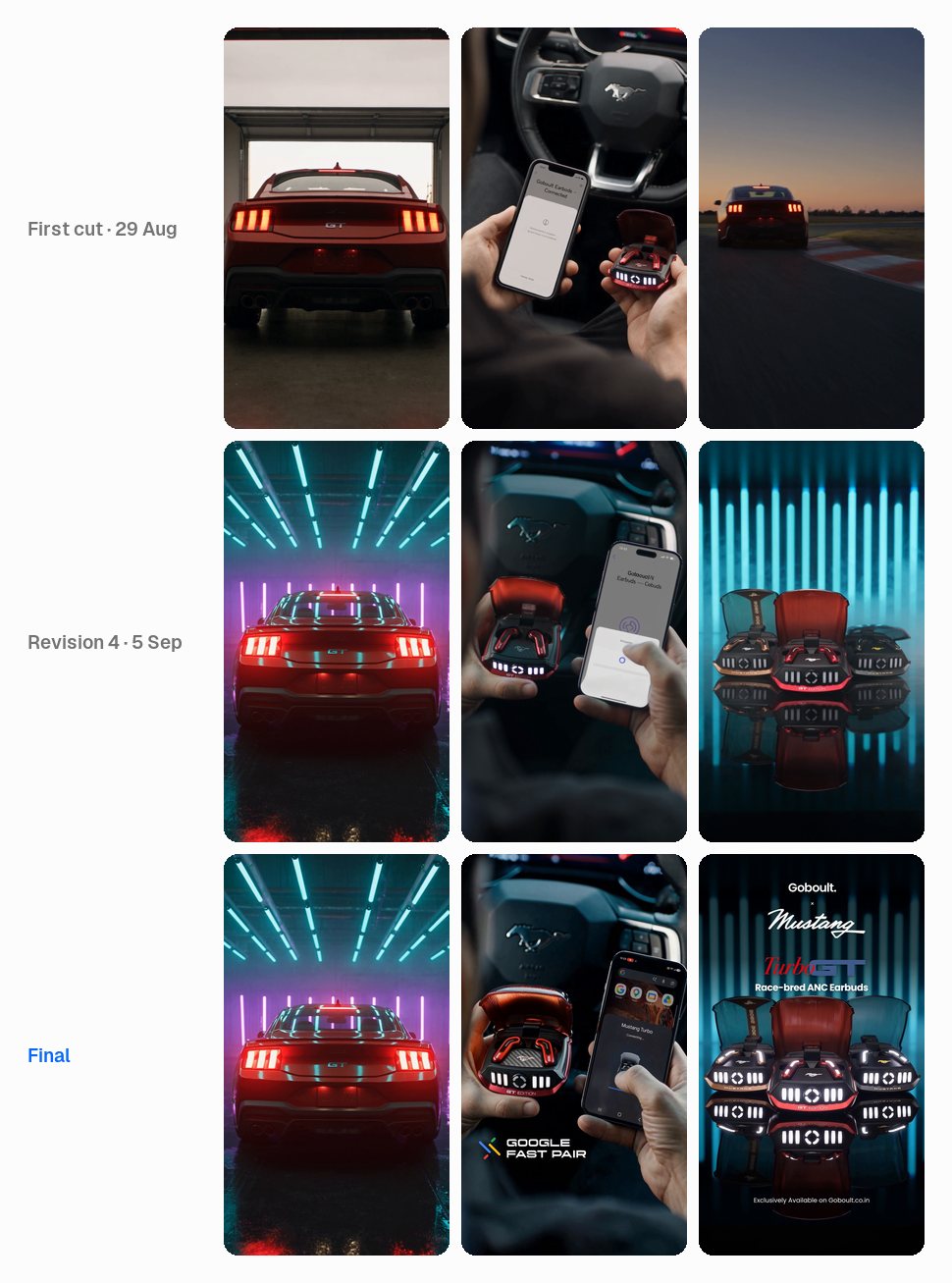
The big idea in our first draft was match cuts. Every car detail cuts straight to the same detail on the earbuds, and a callout names it.
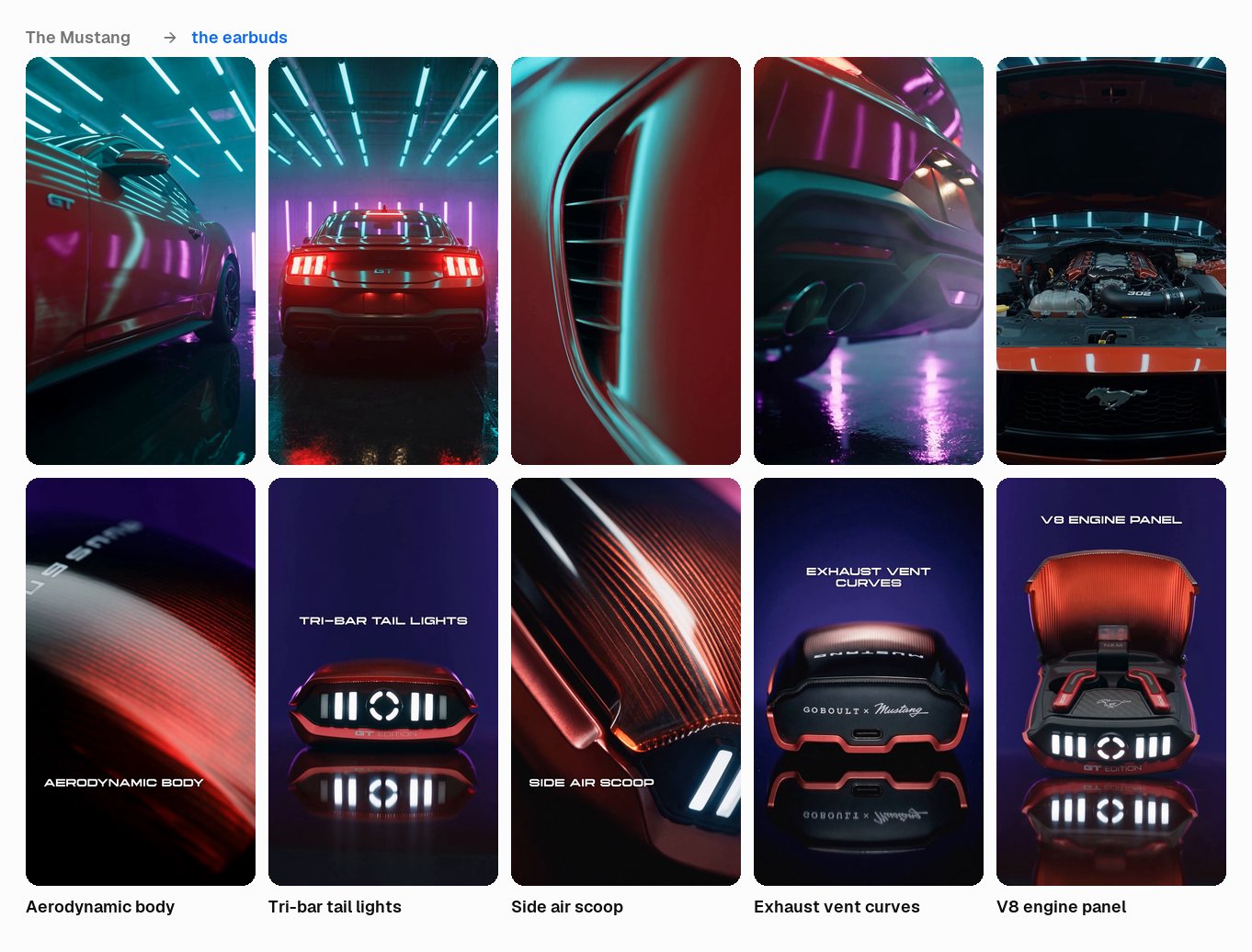
The tail lights become the case's LED bar. The engine bay becomes the open case. Nobody has to be told the design comes from the car. They see it.
The two things AI gets wrong
AI video has two habits that can sink a product launch.
- 1/It redesigns your product. Ask for “Mustang earbuds” and it invents its own.
- 2/It can't keep a car on-model. A fully generated Mustang drifts from shot to shot.
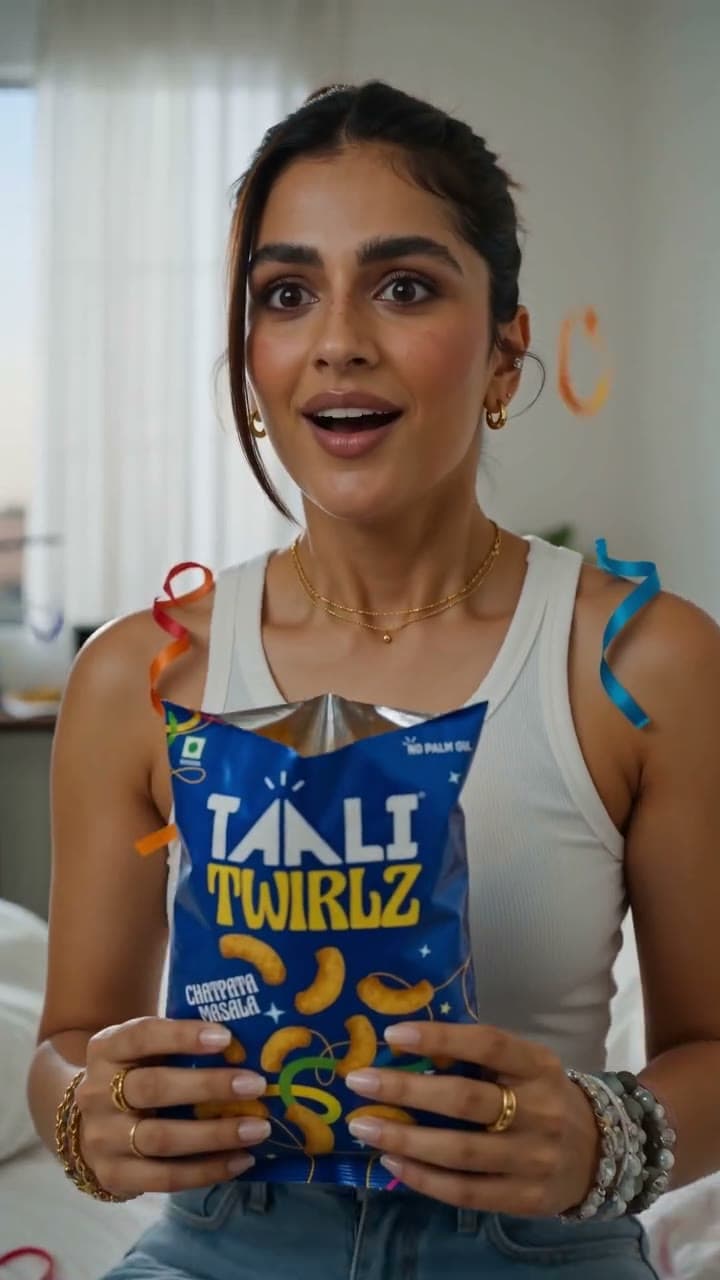
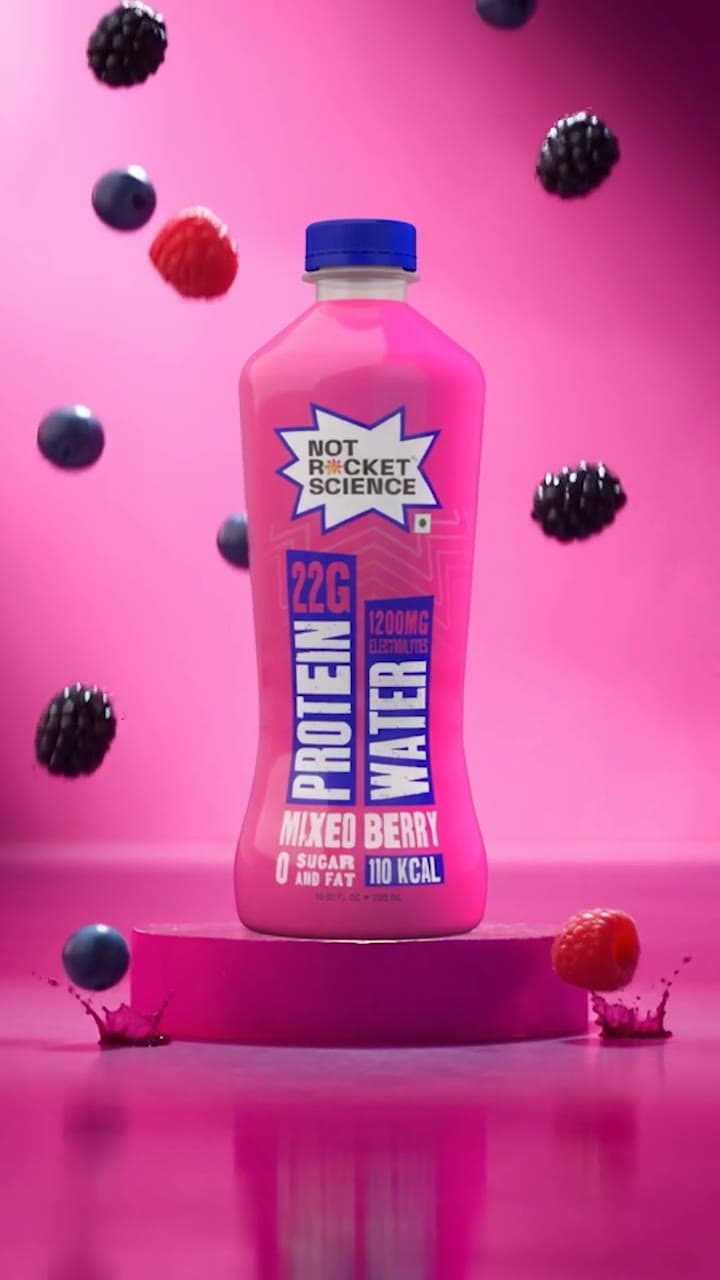
So we set three rules before generating anything, like we did for Taali Twirlz:
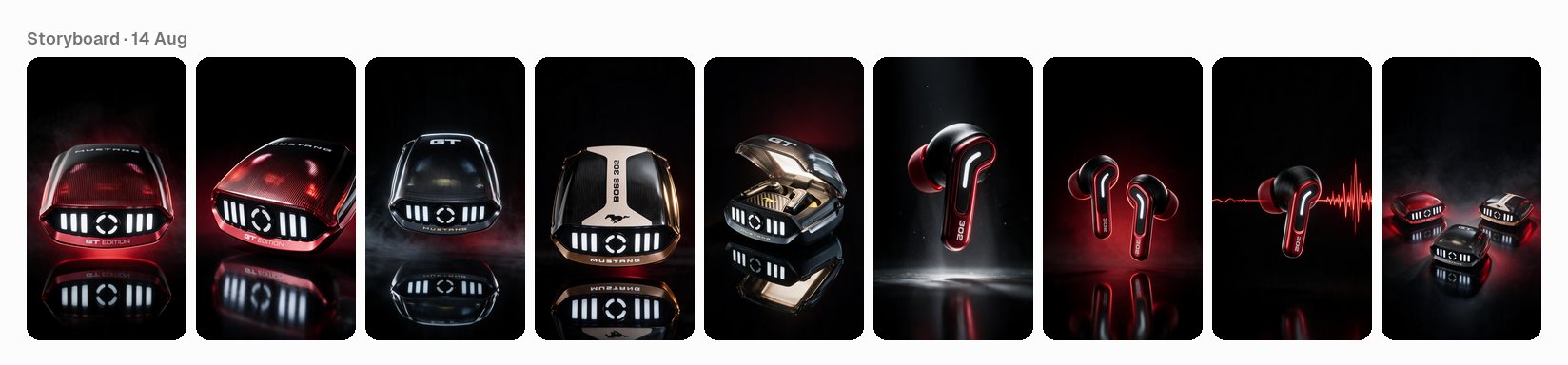
- 1/Product shots start as stills made from GoBoult's real product photos. Motion comes after.
- 2/Car shots lean on details: tail lights, scoops, the engine bay. Fewer full views, fewer chances to drift.
- 3/One colourway per batch, named in every prompt, so the Red Blaze never drifts into the Bronze 302.
T-23: The first cuts didn't match
Both first cuts landed on 29 August.
Each looked good on its own. The car film had a daylight garage and a sunset drive on a track. The product film sat in grey studio smoke. Two good films, two different worlds.
So we threw out both looks and kept the cuts.
Both films moved into one neon tunnel of teal and magenta. Same beats, new world.
T-13: The screen AI couldn't draw
One beat sells Google Fast Pair: open the case and the phone pairs instantly.
AI drew a great hand. A great phone. And a screen that was blank or made up.
So that shot became a post-production job. We took a real screen recording of the earbuds pairing over Fast Pair and tracked it onto the AI phone frame by frame, keeping the thumb on top of the screen.
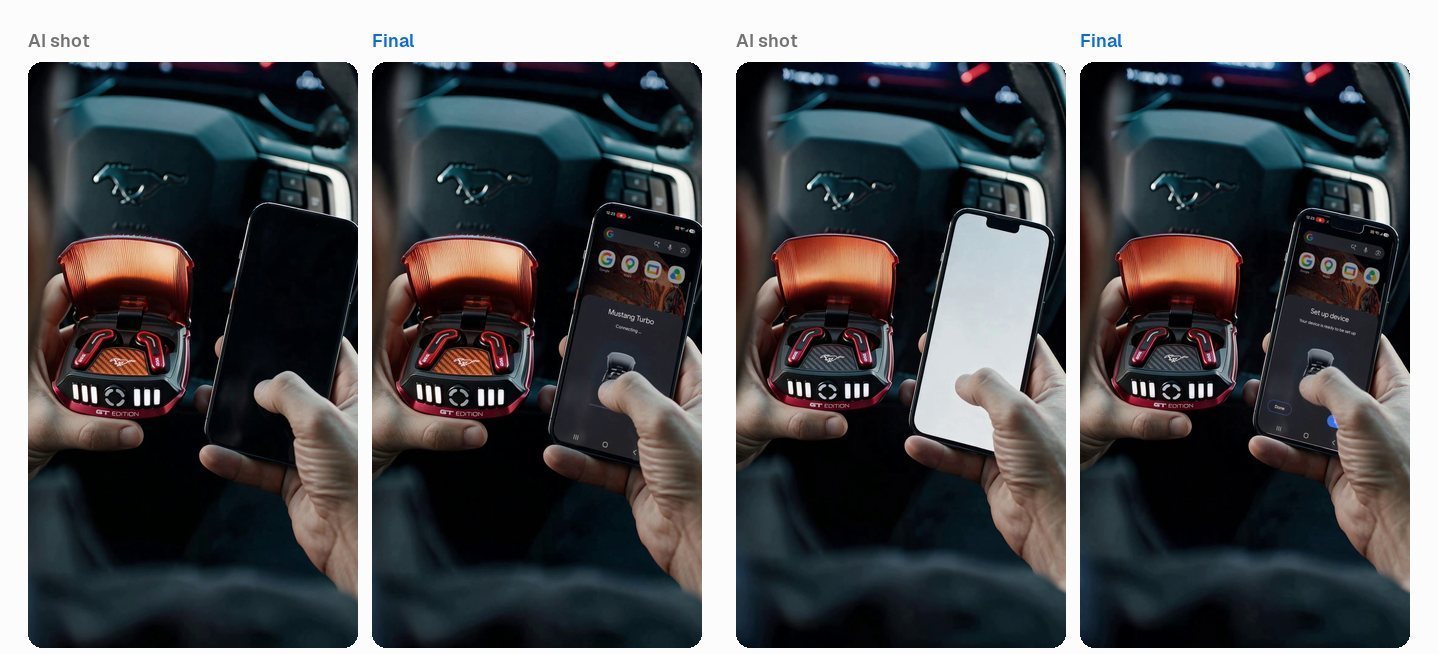
Generation gets you the shot. Compositing makes it true to the product.
T-5: Good to go
GoBoult sent their end-slate copy. We delivered it the next day, in two variations. The reply came back that evening: good to go.
T-0: Live
By 21 September, both films were live. No car hire, no crew, no studio day.
T+14: Now a paid ad
On 5 October, GoBoult started running the product film, the one at the top of this page, as a paid ad on Facebook and Instagram. It's public in Meta's Ad Library.
From storyboard to paid ad in 52 days.
What we'd do differently
The films went well. Our scoping could have been sharper, and that one's on us.
These films were part of a bigger multi-video deal, priced as one bundle. The videos after them were for different products, and one bundle price hid how different each job was.
Here's how we scope every project now:
- 1/Price every film on its own. A product film and a car film with a screen composite are not the same job.
- 2/Write down what one film includes: revision rounds, variations, composites.
- 3/Tie each payment to a milestone both sides can see.
- 4/Name the products a deal covers. A new product gets its own scope.
That conversation belongs before day one.
Viraj
FAQ
Who made GoBoult's Mustang Turbo GT launch films?+
EditGency, the AI production house for D2C brands, made both 9:16 launch films for GoBoult's Mustang Turbo GT, ANC earbuds styled after the Ford Mustang. They were made with AI and no shoot, and were live by 21 September 2026, within 38 days of the first storyboard. On 5 October, GoBoult started running the product film as a paid ad on Facebook and Instagram.
How do you make a product launch film with AI without a shoot?+
Storyboard every shot, generate each product shot as a still from real product photos, approve the stills, then animate them. Real elements like app screens are composited in post. GoBoult's Mustang Turbo GT films went from storyboard to live within 38 days this way.
Can AI video show a real product accurately?+
Yes, if the product is never generated from text alone. Use real product photos as the reference for every shot, approve stills before animating, and generate one colourway at a time. In GoBoult's Mustang Turbo GT films, naming one colourway in every prompt kept the Red Blaze from drifting into the Bronze 302.
How do you show a real app screen in an AI-generated video?+
AI video cannot reliably draw a real interface, so record the real screen and composite it onto the generated phone in post, tracked to the hand with the thumb kept in front. That is how the Google Fast Pair shot in the GoBoult film was made.
How should AI video production be priced and scoped?+
Per film, not as one bundle, because a simple product film and a car film with a screen composite take very different effort. Write down what each film includes, such as revision rounds, variations and post work, name the products the deal covers, and tie payments to milestones both sides can see. That is how EditGency scopes every AI film project now.
Work with EditGency
Want films like these for your brand?
A 30-minute call. We look at your product and tell you what we would make and how long it takes.
Book a call